AI-native product · Multi-agent system · Own system
A multi-agent system for research-based product planning
Craftal is a system Skowak built for itself: a research-based product-planning workspace that turns product context into structured, explorable, and verifiable system models. It's a live system not a concept and it's where much of Skowak's applied-AI practice was developed.
Problem
Product planning in complex domains is a research problem disguised as a management task. The inputs are scattered across documents, conversations, market signals, workflow diagrams, and domain knowledge that no single person holds. Traditional planning tools treat this as project management lists, timelines, dependencies. But the hard part happens before the list exists: deciding what to build, and knowing whether the reasoning that led there is sound.
The system needed to preserve enough operational detail for engineers while remaining legible to product managers, designers, and stakeholders. It also needed to make AI-generated work inspectable instead of asking teams to accept an opaque result.
Approach
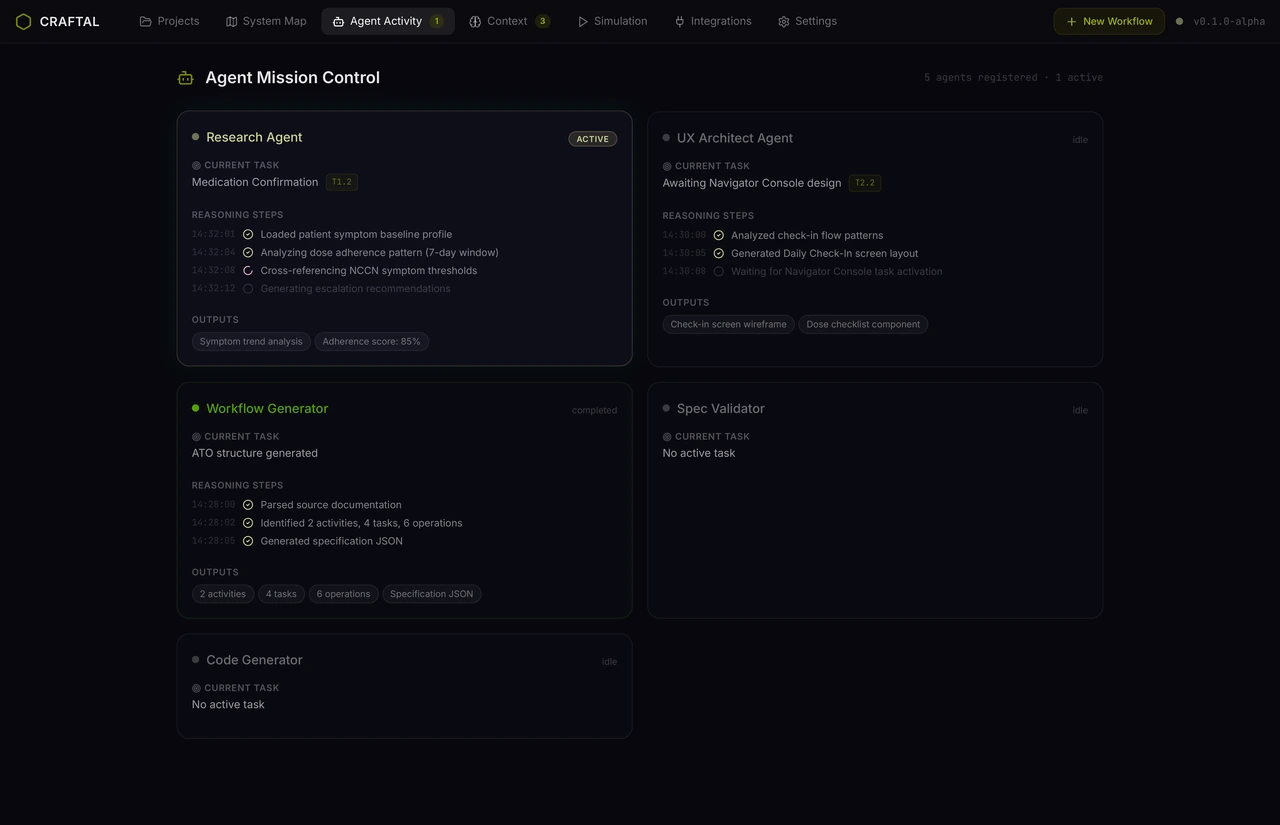
Craftal uses multiple AI agents orchestrated through a custom domain-specific language, with a RAG pipeline that grounds every planning decision in actual research documents, market data, competitive intelligence, and prior decisions. The agents don't plan in isolation; they produce structured outputs that pass through a deterministic verification core before a human reviewer sees them.
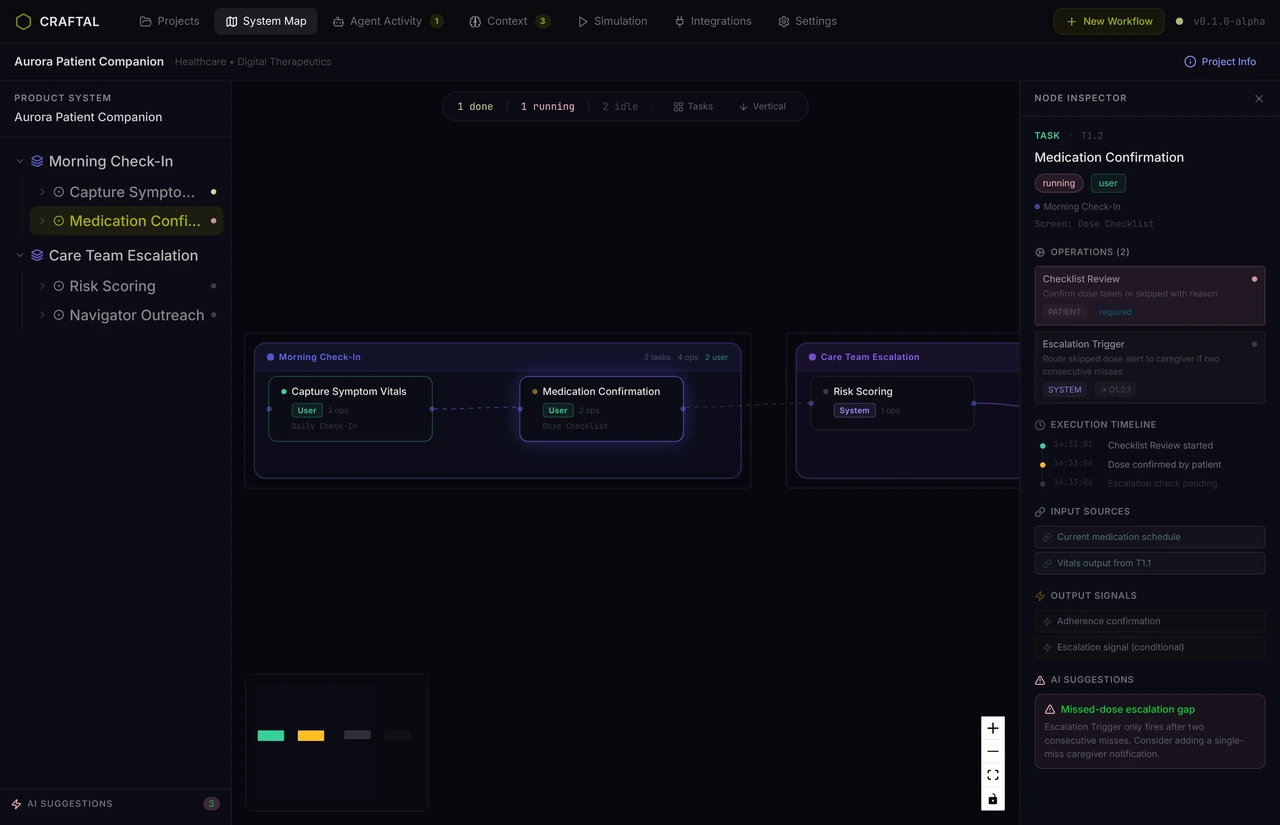
The core model is Activity → Task → Operation. Activities describe major phases of a workflow, tasks represent discrete steps, and operations capture the concrete actors, inputs, outputs, requirements, and dependencies needed to perform each step.
The architecture separates what AI is good at (synthesising large volumes of context, surfacing connections, generating structured proposals) from what it's bad at (knowing when it's wrong). The verification layer catches inconsistencies, unsupported claims, and logical gaps. The human review layer makes the final call.
This is Evaluation-Driven Design applied to the system that does the evaluating: every agent output has measurable criteria for what "good" looks like, and the pipeline won't surface results that fail them.
Impact
- Moves product intent into a consistent workflow specification that teams can inspect spatially, hierarchically, and sequentially
- Research-grounded planning workflows that produce structured, verifiable outputs not ungrounded AI-generated text
- A deterministic verification core that catches inconsistencies before human review, reducing review burden without reducing oversight
- A custom DSL for orchestrating multi-agent workflows, making the planning process reproducible and auditable
- A live system in daily use the evaluation framework, agent orchestration, and human-in-the-loop patterns developed here directly inform Skowak's client work
What made it work
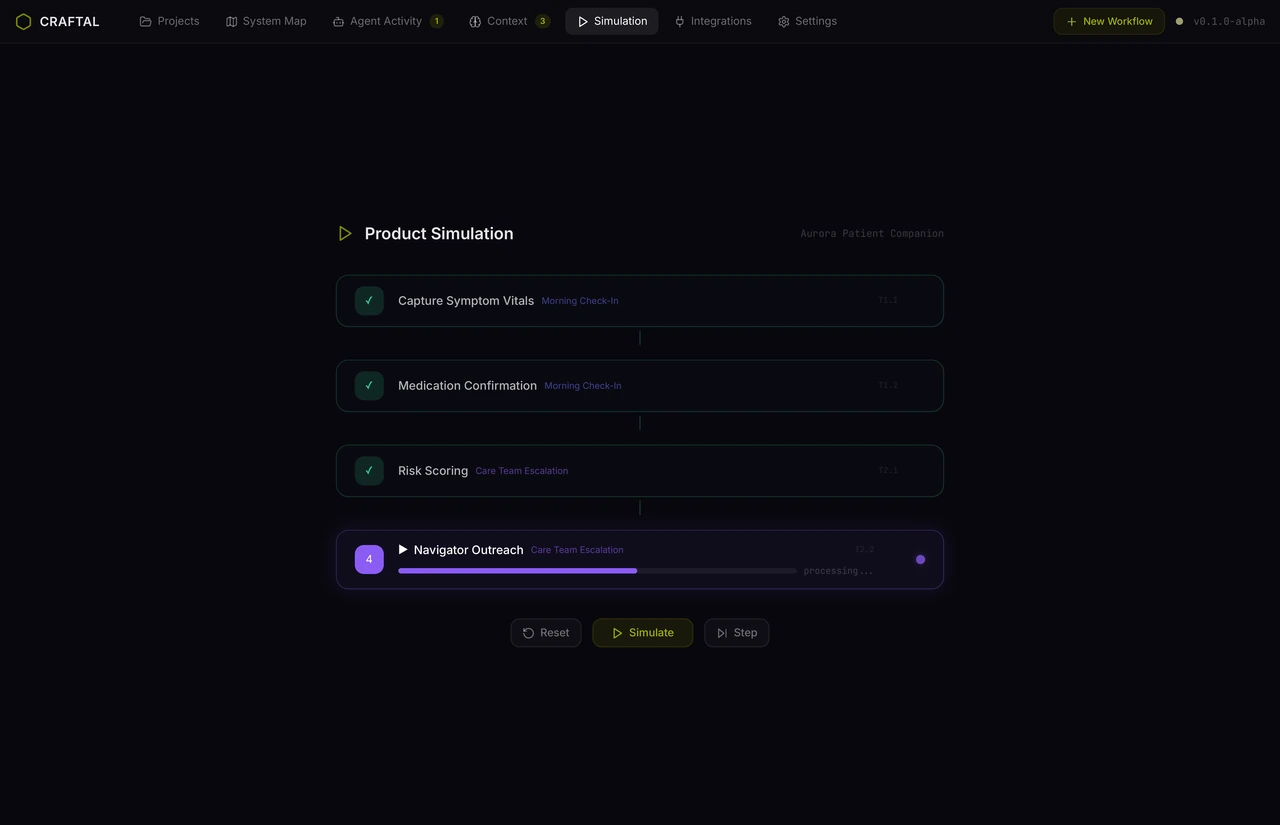
The same principle that runs through every Skowak engagement: separate what needs a human from what doesn't, then instrument the boundary. In Craftal's case, the agents handle synthesis and structure; the verification core handles consistency; the simulation view makes behavior reviewable before implementation; the human handles judgment. Each layer has clear evaluation criteria, and the system knows which layer caught what.
Building AI systems for ourselves not just for clients is where the hard lessons come from. There's no client deadline to hide behind; the system either works in daily use or it doesn't. Craftal, along with Finetunio, CareDash, and Contextus, is part of that practice.
What are you trying to build?
If you're evaluating where AI fits in your operation or you have a project stalled between demo and production, that's the conversation Skowak is built for.